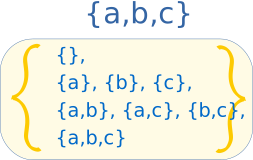
Power set of a set S is the set of all of the subsets of S, including the
empty set and S itself. Power set of set S is denoted as P(S).
For example for {x, y, z}, the subsets
are:
{
  {}, // (also denoted empty set ∅ or the null set)
  {x},
  {y},
  {z},
  {x, y},
  {x, z},
  {y, z},
  {x, y, z}
}
Here is how we may illustrate the elements of the power set of the set {x, y, z} ordered with respect to
inclusion:

Number of Subsets
If S is a finite set with |S| = n elements, then the number of subsets
of S is |P(S)| = 2^n. This fact, which is the motivation for the
notation 2^S, may be demonstrated simply as follows:
First, order the elements of
Sin any manner. We write any subset ofSin the format{γ1, γ2, ..., γn}whereγi , 1 ≤ i ≤ n, can take the value of0or1. Ifγi = 1, thei-th element ofSis in the subset; otherwise, thei-th element is not in the subset. Clearly the number of distinct subsets that can be constructed this way is2^nasγi ∈ {0, 1}.
Each number in binary representation in a range from 0 to 2^n does exactly
what we need: it shows by its bits (0 or 1) whether to include related
element from the set or not. For example, for the set {1, 2, 3} the binary
number of 0b010 would mean that we need to include only 2 to the current set.
abc |
Subset | |
|---|---|---|
0 |
000 |
{} |
1 |
001 |
{c} |
2 |
010 |
{b} |
3 |
011 |
{c, b} |
4 |
100 |